
A habit-building app that turns chores into a game
What is Chores War
Chore Wars is a habit-building app designed to help people build sustainable household habits through play. Instead of relying on rigid to-do lists, the app transforms chores into a friendly Tic Tac Toe game played between partners or housemates.
The goal is simple: make chores fun enough that people actually want to do them.
Table of Contents
The Problem
Ever since I started working from home, my partner and I have become increasingly chore-lazy. Small tasks were constantly postponed, unfinished chores piled up, and everything eventually stacked up at the end of the month.
We tried multiple to-do list and chore-management apps. While they worked well at first, we always abandoned them after a short period. This led me to reflect on why these tools weren’t working for us.
Why Traditional Chore Apps Fail (for People Like Us)
There are hundreds of productivity and chore apps on the market. They are designed to organise tasks, improve productivity, and motivate users through structure. While useful, they often fall short when it comes to repetitive household chores.
Chores are:
Repetitive and routine
Never truly “finished”
Dull, unavoidable, and lifelong
In one lifetime, a person might wash dishes thousands—if not millions—of times. No checklist can make that exciting.
From my own experience, I identified three main reasons why we stopped using chore apps:
Over-structuring doesn’t work for us
Some people function better with flexible, messy systems. Highly structured lists feel restrictive rather than helpful.Too much structure creates task anxiety
Endless lists and reminders make chores feel heavy and intimidating. Instead of motivating us, they trigger avoidance.High setup effort
Someone has to organise, assign, and maintain the chore list—and that already feels like another chore.
These insights made it clear that building another to-do list app wouldn’t solve the problem.
What we actually needed wasn’t better organisation—it was better motivation.
The Idea
Instead of forcing ourselves to complete chores, what if we could build habits naturally?
That’s when the idea clicked:
What if chores were a game?
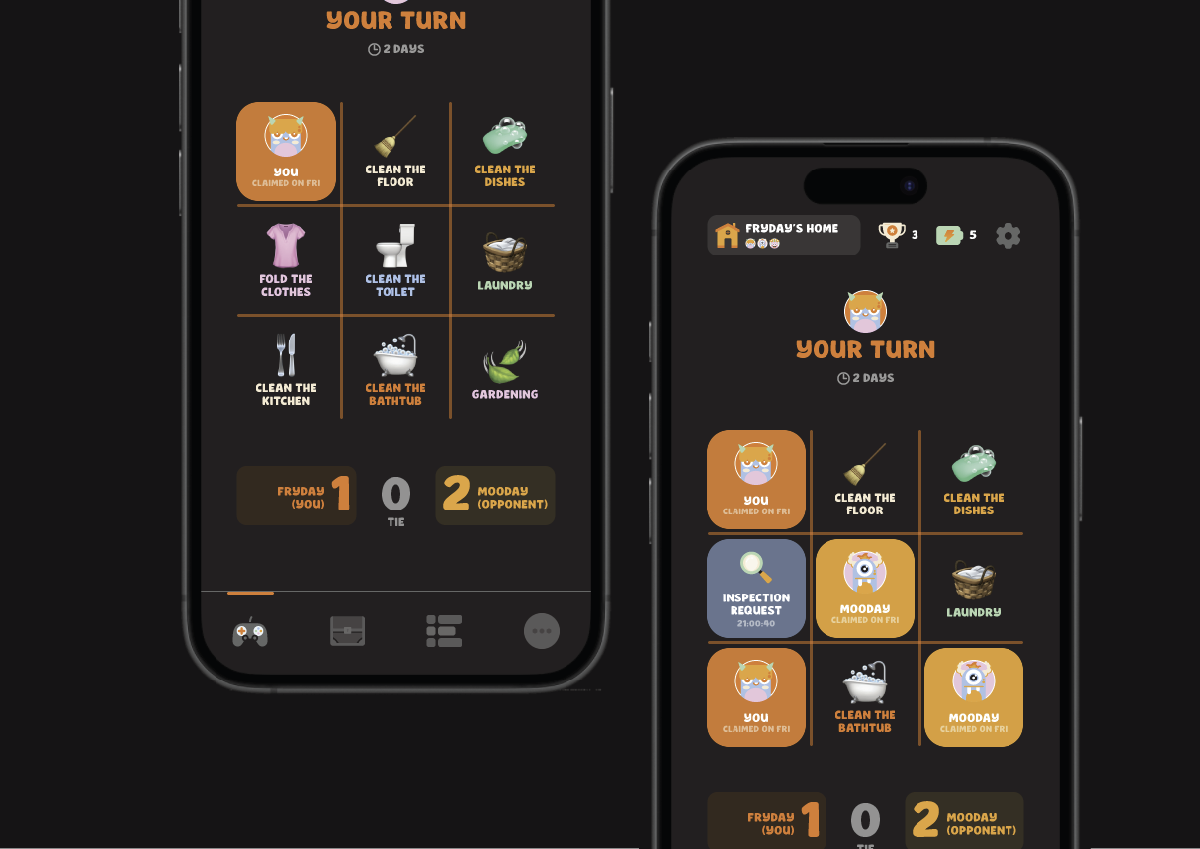
Chore Wars turns household chores into a Tic Tac Toe match:
One player starts by completing a chore
They request an inspection from their partner
Once approved, the chore fills a tile
The first player to complete a line wins
The chore is no longer the focus—the game is.
Motivation comes from play, competition, and shared accountability.
Design Thinking
I approached this project with a user-centred design mindset, starting from a real problem in my own household. Rather than asking “How do I organise chores better?”, I reframed the question:
How might we make chores feel less painful—and maybe even enjoyable?
Understanding the Users
The primary users are:
Couples or housemates sharing chores
People who have tried productivity apps but failed to stick with them
Users who struggle more with motivation than understanding what needs to be done
The key insight was that motivation fails when chores feel emotionally heavy. Traditional apps focus on discipline and structure, but chores require something different: emotional engagement.
Defining the Core Problem
From research and self-reflection, there are three main problems that I found:
Chores feel boringggggg and never-ending ♾️
Structured task lists increase pressure 🫨
Motivation fades quickly without emotional reward
This led to my design goal:
Create a low-pressure system that builds habits through fun, play, and social interaction—without relying on rigid task lists.
Ideation: Gamifying Chores
Tic Tac Toe became the foundation because it is:
Familiar and easy to understand
Quick to play, reducing mental load
Naturally competitive and social
By turning chores into “moves” rather than tasks, the app shifts focus away from obligation and toward play. Completing chores becomes a side effect of trying to win a game.
Design Principles
Chore Wars is guided by four (or maybe 5) core principles:
Fun over perfection – progress matters more than completion
Low mental load – minimal setup and planning
Shared motivation – friendly competition over self-discipline
Habit over productivity – consistency over streaks or counts
And not made for OOCs and perfectionists - it is a game, not a to-do list
The Concept
The prototype focuses on turning the core idea—doing chores through play—into something simple and fun to use. Instead of designing another task flow or checklist, the experience is built around a familiar Tic Tac Toe game.
Game Flow
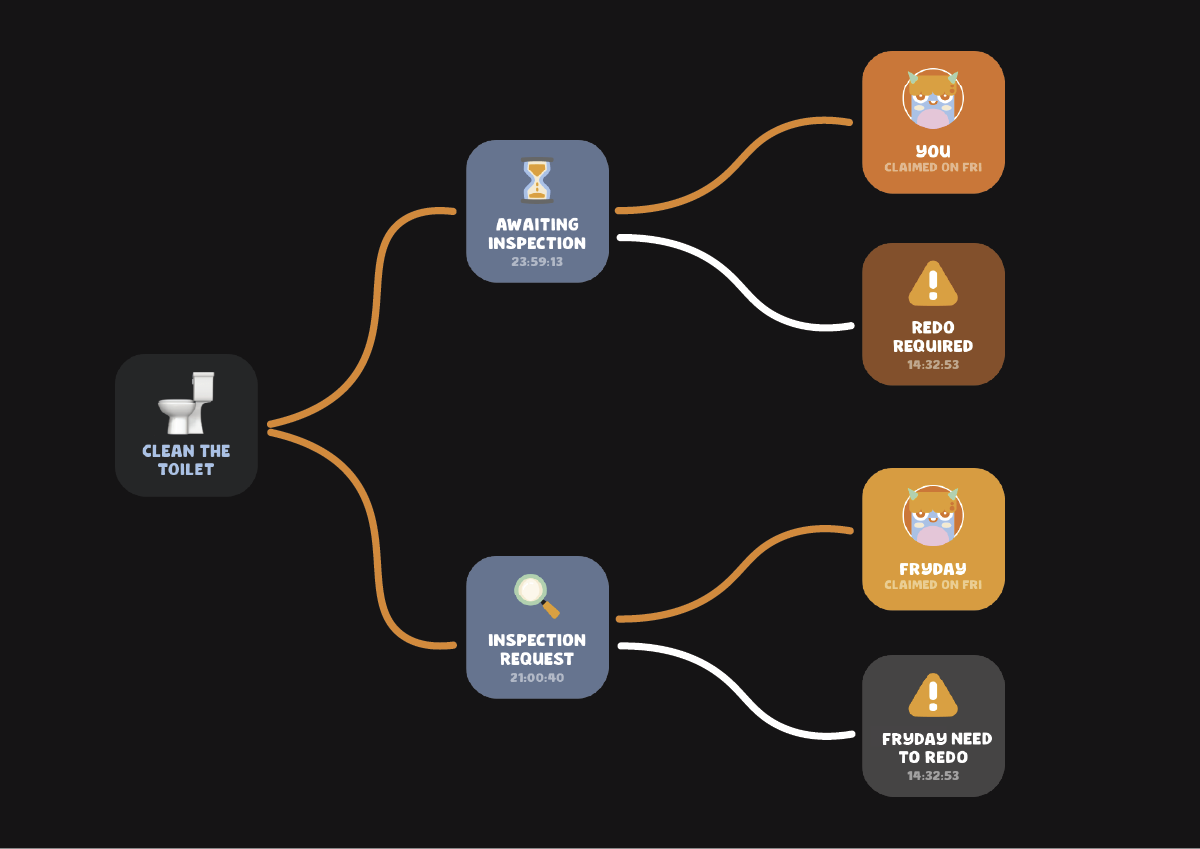
Just like a normal Tic Tac Toe game, players take turns making a move. The difference is that a move can only be made by finishing a real-world chore.
The first player to complete a chore gets the first move
After finishing a chore, players send an inspection request
A photo can be attached as proof
The opponent can approve the chore or send it back for redo with comments
Once approved, the chore fills a tile on the board
By tying progress to the game instead of a checklist, chores feel less like tasks and more like part of a challenge between two people.
Visual Style
I wanted the app to feel more like a game than a productivity tool.
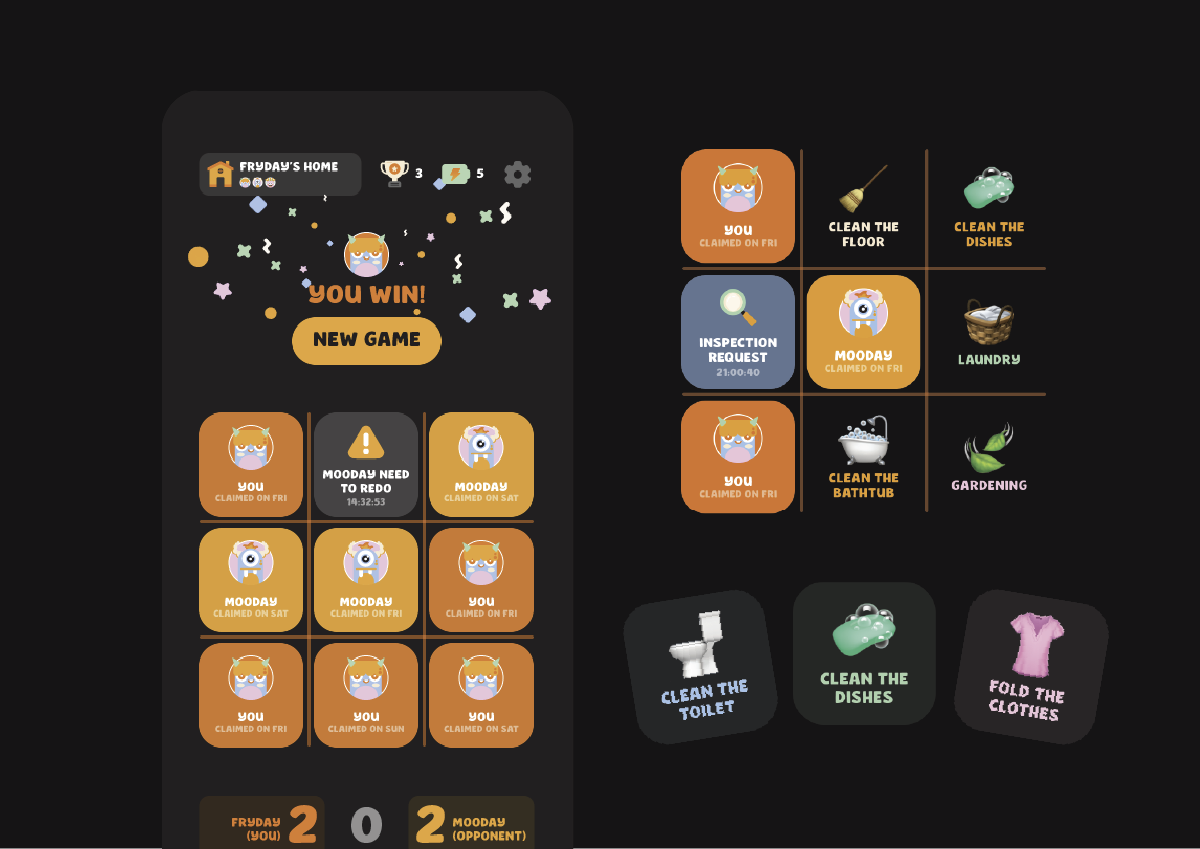 The app uses dark mode to keep things calm and reduce visual clutter
Bright, colourful text is used to highlight game states, scores, and actions
Rounded fonts help create a playful and friendly tone
Large status text like “Your Turn” makes it easy to understand what’s happening at a glance
Overall, the visual style is designed to feel modern, playful, and low-pressure.
Chores as Game Pieces
Chores are treated as game pieces instead of to-do items. Each completed chore becomes a move on the board, making progress visible and fun.
 Showing past matches scores help remind users of their wins and keep motivation going, while future ideas like trophies or simple leaderboards could add extra excitement without turning chores into pressure.
Inspection & Fairness
Since chores affect the game outcome, a simple inspection system is built in.
Players can approve or reject a chore
Photos and comments help explain the decision
The system stays simple to avoid turning inspections into another chore
This keeps accountability between players rather than enforced by the app.
Design Intent
Every design decision in this prototype is aimed at one thing:
making it easier to start and continue doing chores.
Instead of pushing productivity or efficiency, the app focuses on motivation, consistency, and shared fun—so chores become something users naturally return to, one game at a time.
What's Next?
Development! I am currently working on user testings and finishing the prototype. Stay tuned to get the latest update of this case study on my way working on it~